
Hello Today we will be having a look at Looping Functions Available in Appian WIth their Use cases.
- a!forEach
- apply
- all
- any
- filter
- merge
- none
- reduce
- reject
Let’s Start with All Time Famous
>>a!forEach
Here we are Trying to Find Multiples of 3
a!forEach(items: enumerate(10)+1,expression: fn!product(3,fv!item)),With Help of Apply we are aslo able to achive the same Output
- fv!item (Any Type): The current item
- fv!index (Integer): The current item’s index in the items array
- fv!identifer (Any Type Array): When items are a DataSubset with identifiers, the current item’s identifier, otherwise null
- fv!isFirst (Boolean): True for the first item in the items array, otherwise false
- fv!isLast (Boolean): True for the last item in the items array, otherwise false
- fv!itemCount (Integer): The total number of items (including nulls)
apply(fn!product,{enumerate(17)+1},3)
>>apply
With Help of Apply we are aslo able to achive the same Output
apply(fn!product,{enumerate(17)+1},3)
When we Try to Compare both Blocks Of Code we can easily Reduce the blocks of Code by Using Appian Given Functions.
>> all
all( a!isNotNullOrEmpty, {1, 2, null, 3, null, 4} )
It will keep Dive and Check for All saving iteration time with an Overall One Result.
>> any()
It can be considered the Opposite of all Function
ex: any( a!isNullOrEmpty, {null, 1, 2, 3, 4, 5} ) It will check if any of the desired Function results exists.
>> filter()
filter( predicate, list, context )
ex : filter(a!isNotNullOrEmpty,{1, 2, null, 3, null, 4})
>> merge
It takes the Number of Lists and merges them into a single list.
Additional info We also have such function for strings named tostring() and for multiple we can make use of touniformstring()
>> none
Note: we have limitations with this function i.e we cannot use a!forEach() with none()
ex : none(a!isNullOrEmpty,{1, 2, null, 3, null, 4})
>> reduce
ex: reduce( fn!substitute, “abcdefg”, {“a”, “d”, “f”}, “#” )
>> reject
ex : reject( a!isNullOrEmpty, {1, 2, null, 3, null, 4} )
These are Looping Functions that Play a vital role in optimizing the code and making fewer iterations.
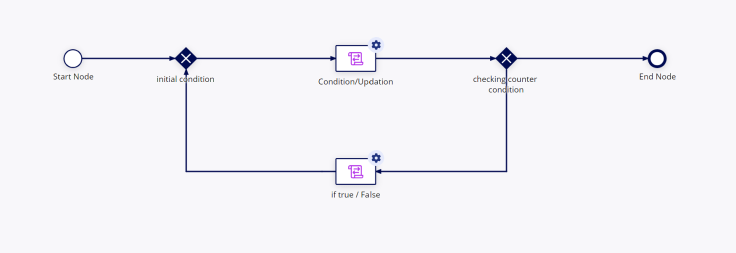
We Can Also Design Our Custom Loop Using a Process Model in Appian By Handling Counter Variables and Checking conditions using Gateways.
Have a best Day Guys.
Discover more from Appian Tips
Subscribe to get the latest posts sent to your email.
Leave a Reply